Protecting Children Online: Privacy, Deepfake Risks and EU Age Verification
·Children are not growing up outside the internet. They are growing up inside it. They learn, communicate, play, watch videos, create content and build relationships online. For adults, the internet may be an add-on. For children, it can become part of identity.
That is why “do not click” and “do not post photos” are not enough. Protecting children online means discussing privacy, cyberbullying, fake profiles, grooming, sextortion, phishing, harmful content and the way AI can misuse a photo or voice.
The topic is also timely because the European Union is tightening online protection for minors. In 2026, the Commission urged Member States to accelerate the rollout of a privacy-preserving social media age verification solution and other age checks. This is not a simple ban on the internet. It is pressure on platforms to protect children from content and contact that are not age appropriate.
For related threats, read our articles on AI as an attacker, AI phishing, deepfake scams and vishing, AI and OSINT and AI as defense.
What most often puts children at risk online
Children’s internet safety is not one issue. It is a combination of behavior, settings, trust, technology and rules. The most common risks include:
Sharing personal information.
A child may not understand why posting their school, hobby club, location, photo near home, nickname or parent’s name can be dangerous. Personal data is not only an ID number. A school uniform, bedroom detail or location pattern can also identify a child.
Cyberbullying.
Cyberbullying can look like mocking comments, exclusion from a group, spreading embarrassing photos, threats or fake profiles. It is dangerous because the pressure can continue at home, in the evening and on weekends.
Fake profiles and manipulation.
Not everyone online is who they claim to be. A manipulator can pretend to be the same age, share the same interests or know the same friends. The goal may be trust, photos, personal data or moving the conversation to a private channel.
Phishing and scams.
Children receive scams promising game currency, skins, prizes, gift cards or premium accounts. The goal is to steal an account, payment data or personal information.
Excessive screen time.
Not every problem is a cyberattack. Endless scrolling, short videos, notifications and games can affect sleep, attention, mood and school performance. The goal is balance, not demonizing technology.
Children’s digital footprint: what is posted may not disappear
Children often think in the present. The photo is funny now. The comment is entertaining now. The video gets likes now. But a child’s digital footprint can last. Content can be downloaded, screenshotted, forwarded and stored.
A simple rule helps: do not publish anything you would not want to show a teacher, parent, future employer or the whole class. The point is not fear. The point is consequence.
Deepfake misuse of children’s photos
AI tools can alter photos quickly. Deepfake misuse of children can involve humiliating edits, fake compromising images, extortion, cyberbullying or distribution without consent.
For a child, even a fake image can be a real trauma. Saying “it is not true” is not enough. The social impact can be real.
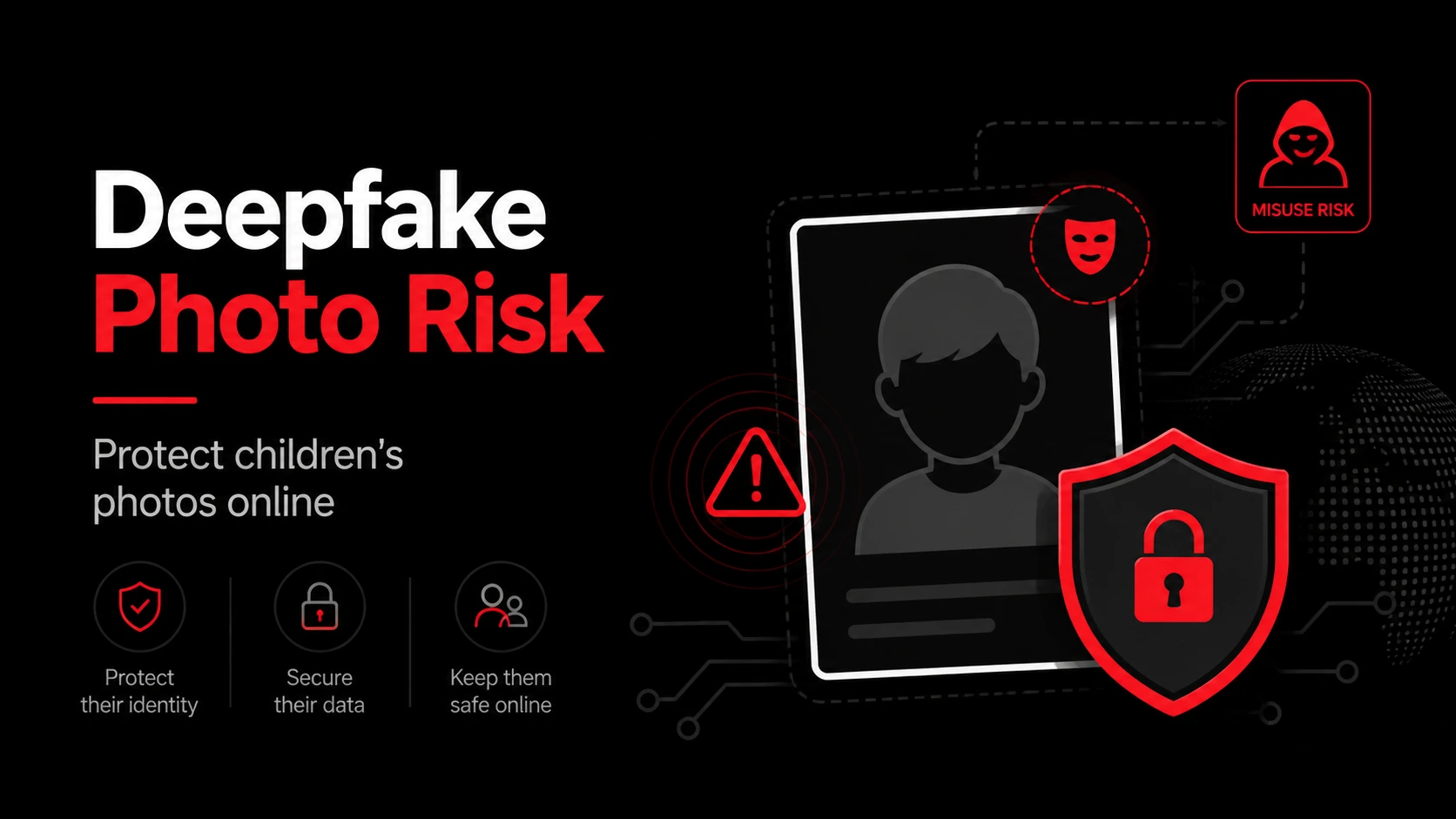
What to do after deepfake misuse of a child's photo?
- preserve evidence: screenshots, links, profile names, dates and times,
- do not spread the content further,
- report the content to the platform and request removal,
- contact the school if the content circulates among classmates,
- contact police when there is extortion, threats or sexualized content,
- support the child and avoid blame.
How to recognize online grooming
Grooming is a gradual process of building trust with a child for manipulation or abuse. It can start with praise, a shared game, gifts, secrets or a move to a private chat.
Warning signs include requests for secrecy, isolating the child from parents and friends, asking for photos, pressure to reply quickly, gifts from an unknown profile, moving to another app or trying to meet in person.
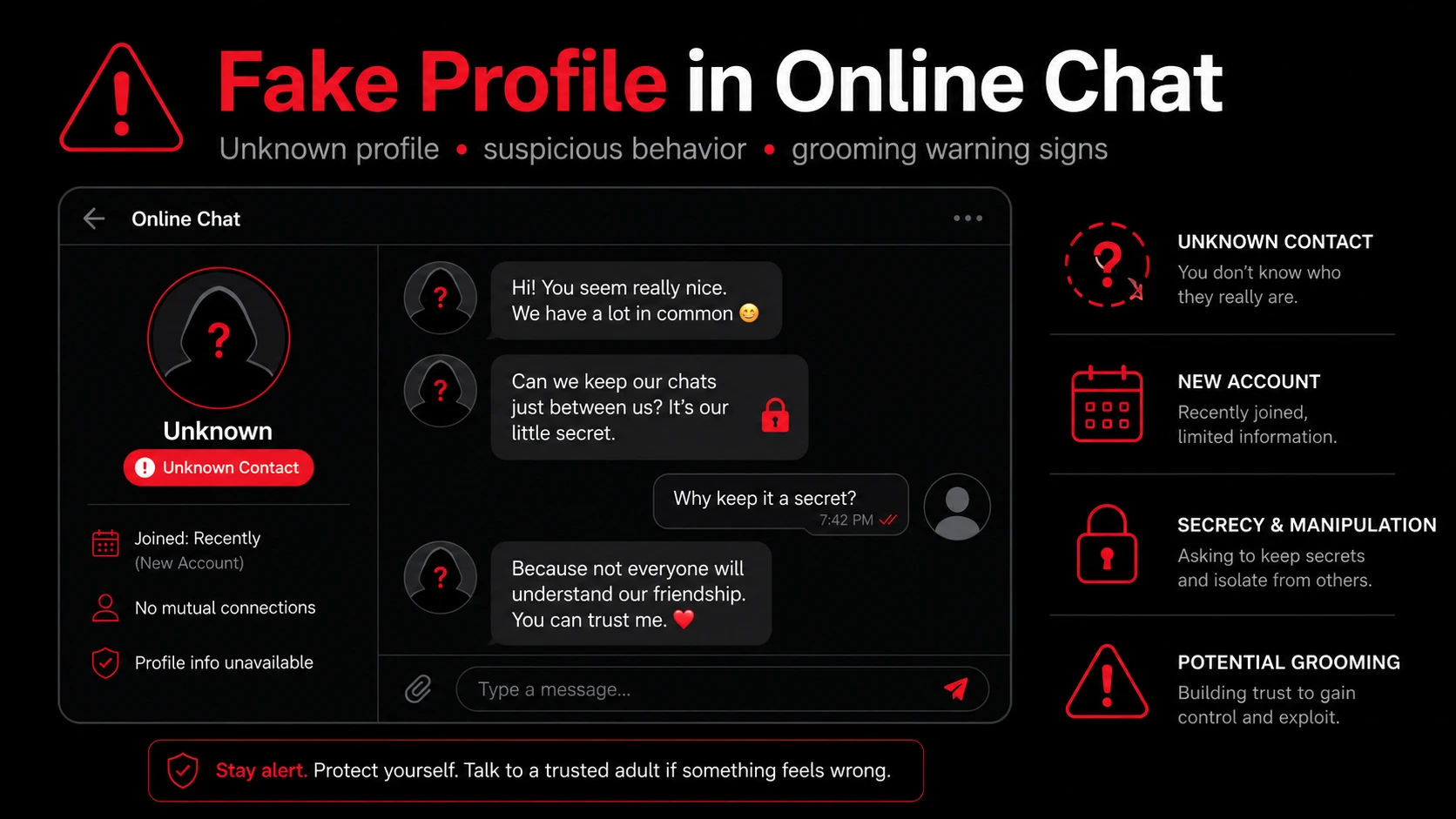
The most important message for a child is: if something goes wrong, punishment does not come first. We help first. Fear of punishment is often why children stay silent when they need help.
Practical rules for parents
1. Set account privacy.
Review social media, game and app settings together. A child’s profile should not be public unless it has to be. Limit who can message, comment and see content.
2. Do not reuse passwords.
If a game password leaks, attackers may reach email or social media accounts. Help children create strong passwords and use a password manager where possible.
3. Turn on multifactor authentication.
Use it especially for email, social media, game accounts and payment-related accounts.
4. Agree on photo rules.
Children should not post photos with addresses, schools, car plates, travel documents, tickets or screens containing personal data. The same applies to parents. Sharenting can create a digital footprint without the child’s consent.
5. Set online time boundaries.
Clear boundaries work better than total bans: no phones during meals, no screens an hour before sleep, homework before gaming or shared weekend rules.
6. Teach children to spot scams.
A free prize, urgent message, unknown link or password request are warning signs. Use examples from their world: TikTok, Instagram, YouTube, Discord, Roblox, Fortnite or game accounts.
7. Save evidence when something happens.
Do not delete everything immediately after cyberbullying or extortion. Screenshots, messages, profiles and timestamps can help the school, platform or police.
What schools can do
Schools have strong influence. Children may tell a teacher or classmate before they tell a parent. Prevention should not be a one-off lecture.
- talk regularly about a safe internet for children,
- explain phishing and scams in plain language,
- treat cyberbullying as seriously as bullying in the classroom,
- teach critical thinking and evidence handling,
- set rules for school groups and communication,
- create a safe way to report problems,
- involve parents in awareness and security training.
This can also be supported through cybersecurity awareness training that explains phishing, social engineering and safe digital habits in practical terms.
AI and children: a new layer of risk
Children can use AI tools for learning, image creation or writing. That is not bad by itself. Risk appears when they upload personal data, other people’s photos without consent, trust fabricated answers or use AI to bypass rules.
Parents and schools should explain that AI can be wrong, personal data does not belong in random AI tools, photos and voices need consent, deepfakes can seriously harm people and online anonymity does not mean impunity.
The EU push: age verification on social media
The European Union is addressing children’s access to social media, video platforms, AI chatbots and age-inappropriate content. Under the DSA, online platforms must ensure a high level of privacy, safety and security for minors.
According to the European Commission, the EU age verification solution has been technically ready for implementation since April 2026. The idea is that a user can prove they meet an age threshold without revealing exact age, identity or unnecessary personal details to the platform.
Proper EU age verification should not mean sending a child’s ID card directly to a social network. The goal is a yes-or-no answer: the user meets the age threshold, or they do not. The platform should not receive more data than it needs.
In 2025, the European Parliament also backed the political idea of an EU-wide digital minimum age of 16 for social media, video-sharing platforms and high-risk AI companions, with parental authorization for children aged 13 to 16. Important: this is not yet an automatic EU-wide ban in every country, but it is a clear signal of the regulatory direction.
Benefits and risks of age verification
Age verification can make fake birth dates less useful, limit access to harmful content and help platforms set privacy, recommendations and contact options by age.
But it must be designed safely. A bad solution could lead to excessive document collection, user tracking or leaks of sensitive data. Age checks should protect children, not create a new sensitive register of their online lives.
Frequently asked questions
Does age verification mean a social network gets the child's ID card?
A well-designed European solution should work differently. The platform should receive only proof that the user meets an age threshold, not the full document or exact identity.
Will age checks be enough to protect children?
No. They are only one layer. Private profiles, safe settings, parental communication, school prevention, reporting tools, technical controls and platform accountability remain necessary.
What if someone threatens or manipulates a child online?
Do not blame the child. Save evidence, avoid panic, do not pay, do not send more content and report the issue to the platform. For threats, extortion or adult contact with a child, involve the school and police.
Useful sources
- European Commission: EU approach to age verification
- European Commission: Member States urged to roll out the age verification app
- European Commission: DSA guidelines on protecting minors
- European Parliament: call for an age threshold for social media
Conclusion
Protecting children online is not about taking technology away. It is about teaching children to use it safely, thoughtfully and responsibly.
The best protection combines trust, rules, technical settings and regular conversation. A child should know that if something unpleasant happens online, they are not alone.
Technology changes, apps change and regulation changes too. One thing stays the same: children need adults who pay attention, listen and help them make good decisions.
