Artificial Intelligence as Defense: AI in the Service of Security
In previous articles, we discussed how attackers can use AI for phishing, deepfakes, OSINT and vulnerability discovery. It would be a mistake to see artificial intelligence only as a threat.
AI cyber defense is just as important as AI-enabled attacks. AI is a tool. In the hands of defenders, it can improve cybersecurity: it helps detect suspicious messages, analyze large volumes of data, speed up incident response and reduce pressure on security teams.
For the attacker perspective, read AI as an Attacker and the article on AI vulnerability discovery.
For the social-engineering side, see the practical guides on AI phishing, deepfake scams and vishing and AI and OSINT.
Why security teams need help
Modern companies produce huge volumes of digital signals: emails, logins, cloud events, network communication, applications, endpoints, user access, login attempts and alerts from security tools.
Even a smaller company can generate thousands of events per day. Larger organizations can have millions. Humans cannot review everything manually. This is where AI in cybersecurity helps: it can find patterns, anomalies and connections hidden in data.
AI for phishing detection
Phishing is one of the most practical areas for AI defense. A modern phishing filter does not only look for known malicious links. It can analyze message language, sender reputation, domain similarity, attachment type, link behavior and other signals.
AI phishing detection can flag a message that does not contain a known virus but still looks suspicious: it creates urgency, asks for credentials, uses an unusual link or pretends to be internal communication.
No filter catches everything. The best defense combines technology with trained people. The filter reduces attack volume. People must still recognize what gets through.
AI for security monitoring
Security monitoring watches what is happening across systems. AI can help detect unusual behavior and support threat detection.
Examples include:
- a user logs in from a country they never used before,
- an account starts downloading an unusual amount of data,
- an employee tries to access systems they normally do not use,
- a device communicates with a suspicious domain,
- many failed logins happen at night,
- an administrator account performs unusual changes.
One event alone may not mean an incident. AI can connect multiple signals and show that something does not fit. In practice, this is often connected with SIEM, EDR and cloud security tools.
AI for incident response
When an incident happens, time matters. The security team needs to understand what happened, who is affected, which systems are involved and what action is needed.
AI can summarize events, suggest next steps, rank priorities and prepare a short overview for decision makers. In incident response, it can save analysts time when reviewing logs and alerts.
For example, AI may summarize: "The user account was compromised. First there was a login from an unusual location, then a mail forwarding rule was created, followed by an attempt to access shared documents."
This saves time. But the result still needs human verification.
AI for finding vulnerabilities
AI can also help developers. It can review code, point to risky patterns, suggest safer implementation and explain problems in simpler language.
This matters because security experts are scarce. Developers work under pressure, and security can feel like a blocker. If AI helps find a flaw while code is being written, it is cheaper and faster than fixing it after an incident.
AI is not an excuse for a weak process. Code review, testing, security rules and clear responsibility still matter.
AI for employee training
Good cybersecurity awareness training should not be a boring presentation once a year. AI can help create realistic but safe training scenarios.
A company can prepare simulated phishing messages by role: different examples for finance, sales and HR. Employees learn on situations that resemble their real work.
Where AI has limits
AI is not infallible. It can miss context, classify normal activity as an incident or underestimate real risk.
The main risks in AI defense are:
- blind trust in recommendations,
- poor tool configuration,
- lack of human oversight,
- sensitive data leaking into unsuitable AI tools,
- false positives,
- unclear responsibility.
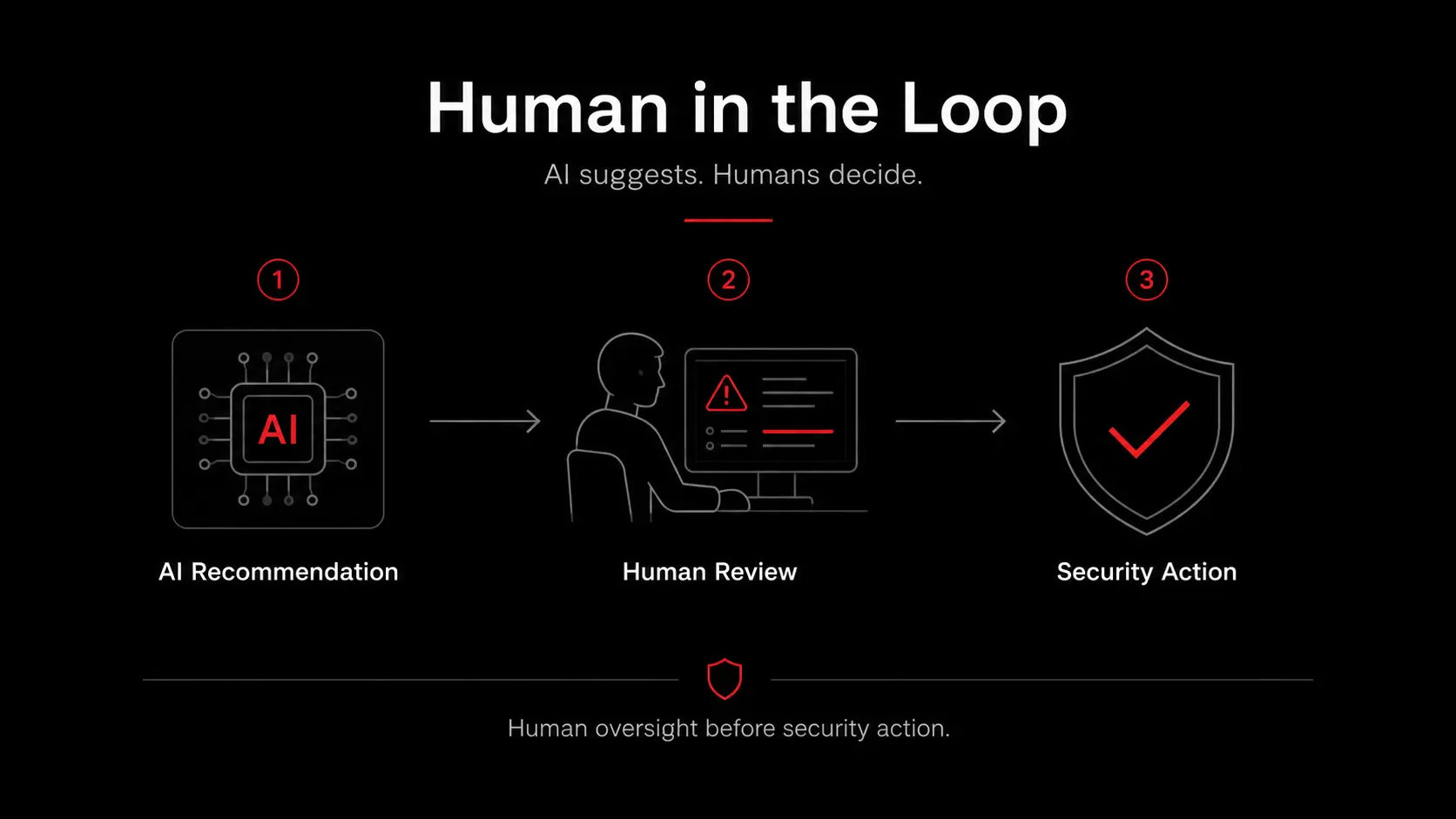
The rule is simple: AI suggests and helps, humans decide.
What companies should introduce
1. Define what data can go into AI tools.
Sensitive information does not belong in random public tools.
2. Set rules for AI usage.
Employees should know what is allowed and what is not.
3. Use AI where it reduces risk.
Examples include phishing filters, monitoring, incident summaries, code review and SOC automation.
4. Keep human oversight.
Especially for incidents, account blocking and business-impacting decisions.
5. Measure results.
Check whether AI reduces incidents or only produces more alerts.
6. Combine AI with classic controls.
MFA, backups, updates, least privilege and zero trust remain the foundation.
AI does not replace security culture
You can have excellent tools, but if people cannot report suspicious email, payments are approved chaotically and accounts do not use MFA, AI will not save you.
Cybersecurity is a combination of people, processes and technology. AI belongs to technology, but it must be connected to process and understood by people.
AI is not an autopilot without a driver
The biggest mistake is believing AI will solve everything alone. Security needs context: which systems are critical, who has access, what behavior is normal and what is an exception.
That is why the human-in-the-loop principle matters. AI recommends, alerts, ranks or explains. A human confirms, rejects or adds context.
Conclusion
Artificial intelligence will play a larger role in defense. It will help filter phishing, detect anomalies, analyze incidents, find vulnerabilities and train people.
It is not a magic shield. It is an amplifier. If you have good security processes, AI can speed them up and improve them. If you have chaos, AI can accelerate chaos.
The best approach is simple: use AI, but do not let it decide alone. Trust it as an assistant, not as an autopilot.