AI as an Attacker: Phishing, Deepfakes and New Cyber Threats
Artificial intelligence is now everywhere. It helps people write, analyze data, translate, code, answer customers and speed up daily work. But every powerful technology has another side. The same tools that help ordinary users and companies can also help attackers.
This is especially visible in AI cybersecurity. An attacker no longer has to be a genius who spends days manually searching for bugs in systems. Very often, something simpler is enough: convince a person to click a link, enter a password, pay an invoice, open an attachment or share a one-time code.
That is why phishing remains one of the easiest ways to reach money, accounts, data or company systems. AI makes phishing more convincing, more scalable and harder to recognize.
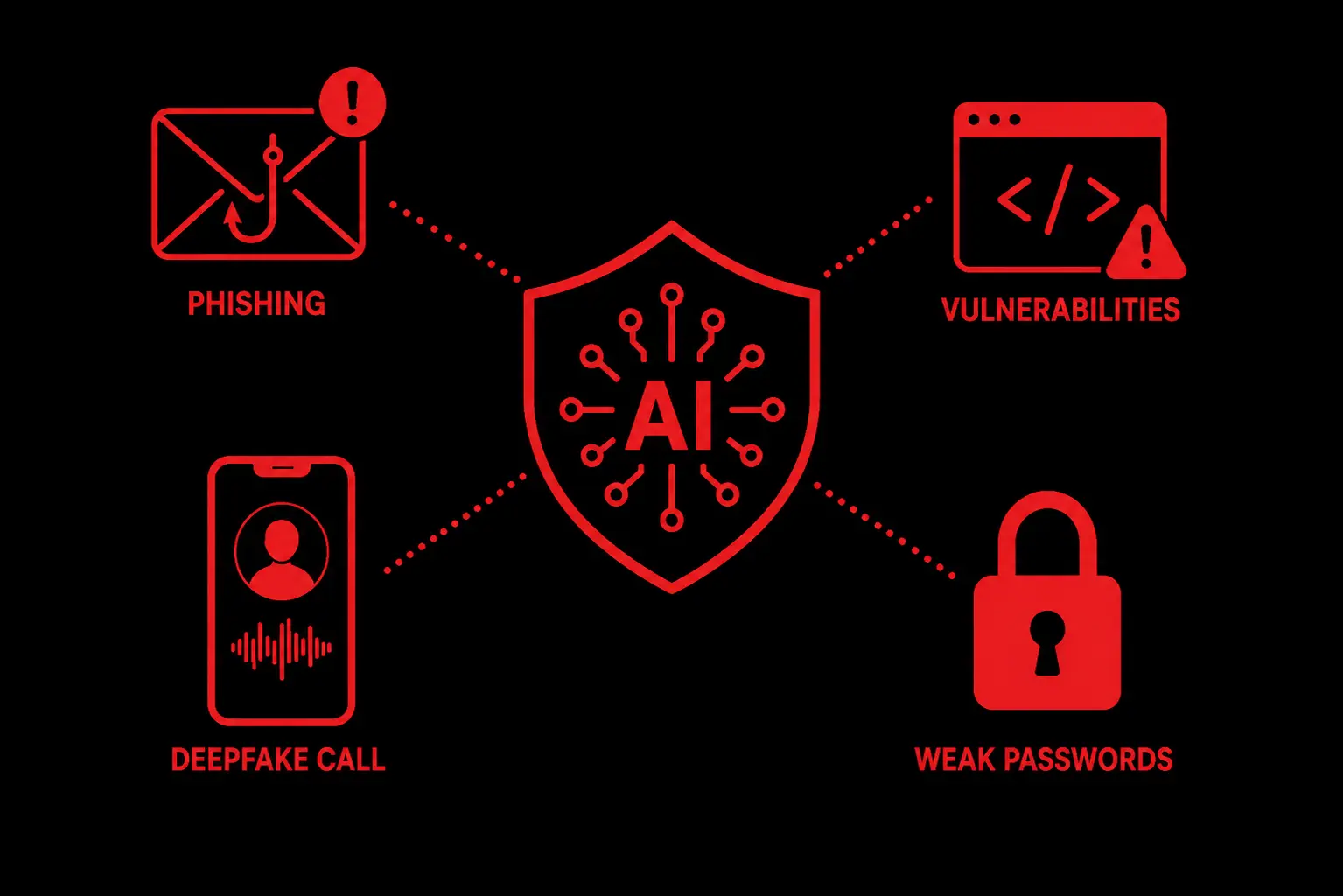
Treat this article as the pillar guide for our series on AI and cyber threats. More detailed guides cover AI phishing, deepfake scams and vishing, AI and OSINT, Mythos, Aardvark and AI vulnerability discovery, AI as defense and protecting children online.
Why phishing is still so effective
Phishing works because it does not primarily attack technology. It attacks people.
An attacker does not need to break a firewall if they can persuade an employee to hand over credentials. They do not need to find a complex software vulnerability if someone opens a malicious attachment. They do not need to hack a bank if they can scare a person into believing their account will be blocked.
Phishing uses emotion: fear, curiosity, stress, time pressure and trust in authority. Typical messages look like this:
- "Your package could not be delivered. Click here."
- "Your account will be blocked within 24 hours."
- "Please pay this invoice urgently."
- "I need your verification code, we are handling an incident."
- "Here is the document for today's meeting."
In the past, phishing was often easier to spot because of bad grammar, strange translations or unprofessional design. That is no longer reliable. AI can write in natural English, Slovak, German, Czech and many other languages. It can match a company tone and produce an email that looks like normal business communication.
If you need a practical checklist for recognizing phishing, continue with our guide on what AI phishing is and how to recognize it.
How AI strengthens social engineering
Social engineering means manipulating a person instead of a system. The goal is to build trust and push the victim into a situation where they act quickly without verification.
AI helps this process in three main ways.
First, it improves language. An attacker can write a message in English, German, Slovak or Czech without speaking the language. The text can sound formal, friendly, executive or technical, depending on the target.
Second, it improves personalization. An attacker can review LinkedIn, company websites, press releases, job ads, social media comments and public documents. AI can then turn these fragments into a specific story. For example: "Hi Peter, I saw your team is working on the new logistics project. I am sending the updated contract draft."
Third, it improves scale. Creating hundreds of personalized phishing messages used to be slow. Today, it can take minutes. Attackers can quickly prepare campaigns for different companies, departments, languages and job roles.
The result is less random spam and more convincing messages that blend into everyday work.
Deepfakes and fake voice calls
Another major risk is deepfake scams. A deepfake is artificially created or modified audio, video or image content that pretends to show a real person. In practical terms, it means we can no longer automatically trust that a person we hear or see on a screen is really that person.
The biggest risk today is voice fraud, often called vishing. An attacker can imitate the voice of a CEO, colleague, family member or customer. A short voice sample from a video, podcast, online meeting or social media can be enough for modern tools to create a convincing fake voice.
Imagine this scenario: the finance team receives a call. The voice sounds like the director. He says he is travelling, cannot explain details and needs an invoice paid immediately. Or HR gets a message from an "employee" asking to change the payroll bank account. Or a parent receives a call from a "child" who claims to be in trouble and needs money quickly.
This is not science fiction. It is how AI moves scams from text messages into voice and video manipulation.
For verification steps and warning signs of fake voice calls, see the dedicated guide on deepfake scams and vishing.
OSINT: attackers use information we publish ourselves
OSINT means collecting information from publicly available sources. It sounds technical, but in practice it includes things we see every day: LinkedIn profiles, company websites, conference photos, employee lists, job ads, public registers, social networks and comments under posts.
For an attacker, this information is valuable. They can identify the CEO, finance staff, IT administrators, suppliers, technologies mentioned in job ads and even travel or conference schedules.
AI can connect these pieces into a convincing pretext. It is no longer a generic "dear customer" email. It is a message that knows the name, context, project, role and language of the company.
That is why cybersecurity does not start only with antivirus software. It also starts with what we publicly share about ourselves and our business.
The practical side of this topic is covered in AI and OSINT: how attackers use public information.
Autonomous vulnerability discovery: Aardvark, Mythos and the new reality
AI is also changing the more technical side of cybersecurity. New models can read code, identify suspicious patterns, test bugs and suggest fixes. That is a major advantage for defenders, developers and security teams.
One example is Aardvark, later associated with Codex Security, presented as an agentic security researcher. Its role is to analyze source code, find software vulnerabilities, validate them and propose patches.
Another example is Mythos Preview, which showed strong capabilities in vulnerability discovery and validation. For defenders, this is good news because similar tools can help find bugs before they are exploited. At the same time, it is a warning: if AI can help defense, attackers will also want to abuse similar capabilities.
Most people do not need to understand exploit internals, kernels or memory corruption. The key principle is enough: the time between discovering a weakness and exploiting it is getting shorter. Businesses cannot postpone updates, security reviews and monitoring for "later".
For the technical follow-up, read Mythos, Aardvark and AI vulnerability discovery.
AI as defense: useful tool, risky judge
Artificial intelligence is not only a threat. It is also a strong defensive tool. It can help filter phishing, detect suspicious behavior, summarize incidents, analyze logs, review configurations and help security teams respond faster.
The problem is not AI itself. The problem is blind trust.
AI can help, but it should not be the only decision-maker. Security still needs human oversight, clear rules, verification, multi-factor authentication, backups, updates and a healthy level of suspicion.
The defensive perspective is explained separately in AI as defense in cybersecurity.
How to protect yourself in practice
The best protection is not one magic application. It is a combination of simple habits and technical controls.
Start with these steps:
- Verify urgent requests through another channel. If someone asks you to pay an invoice quickly, call them on a known number, not the number in the suspicious message.
- Use multi-factor authentication. Prefer an authenticator app or security key over SMS.
- Do not click links in messages without thinking. Log in directly through the official website instead.
- Train employees regularly, not once a year. AI phishing changes quickly and training must be practical.
- Set clear company rules for payments, bank account changes and sensitive data. No urgent request should bypass control.
- Update systems and applications. As AI tools improve vulnerability discovery, fast patching becomes more important.
- Watch what you publish. Fewer public details mean less ammunition for attackers.
Conclusion: AI did not change the target. It changed the quality of attacks
The attackers' goal is the same: money, data, access and trust. The tools have changed. Phishing is more convincing, deepfake voice calls sound more real, OSINT is faster and vulnerability discovery is becoming more automated.
The good news is that defense does not have to be complicated. Most attacks can be made much harder with common sense, verification, MFA, training, updates and clear internal rules.
Cybersecurity today is not only about IT. It is about trust. In the age of artificial intelligence, one rule matters more than ever: trust, but verify.